 EN
EN
 AR
AR CS
CS DA
DA NL
NL FI
FI FR
FR DE
DE IT
IT NO
NO KO
KO PL
PL PT
PT RO
RO RU
RU ES
ES SV
SV TL
TL ID
ID LV
LV SR
SR SK
SK SL
SL VI
VI SQ
SQ ET
ET TH
TH TR
TR AF
AF MS
MS GA
GA HY
HY KA
KA BS
BS LA
LA MN
MN MY
MY KK
KK UZ
UZ KY
KY
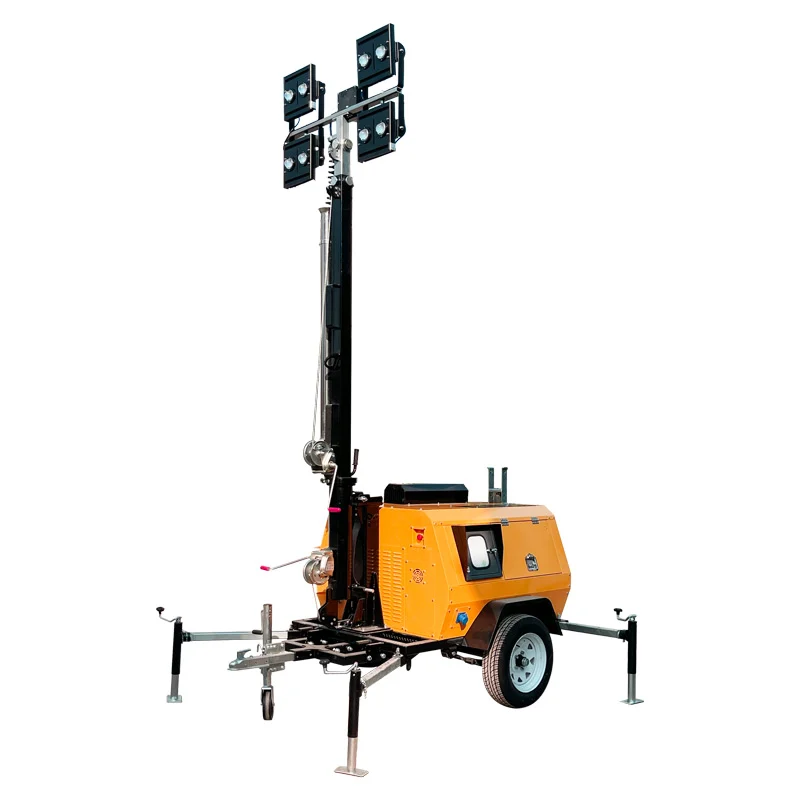
Why Light Tower Mast Height Dictates Illumination Performance
Coverage Area, Uniformity, and the Inverse Square Law Explained
The elevation of a light tower’s mast directly governs both the size and quality of the illuminated area—governed by the inverse square law: light intensity decreases proportionally to the square of the distance from the source. For example, doubling the height from 10 to 20 feet reduces ground-level intensity to one-quarter. This non-linear falloff means that while raising a mast from 15 to 25 feet expands coverage by ~30%, it also dilutes central intensity—creating a fundamental trade-off between area and usable illumination.
| Light Tower Mast Height | Relative Coverage Area | Light Uniformity | Key Performance Trade-off |
|---|---|---|---|
| 15 ft (4.5 m) | Baseline | High central intensity, sharp drop-off at edges | Excellent for small, high-detail tasks; poor for large areas |
| 25 ft (7.6 m) | ~30% larger than 15 ft | Improved overall spread, fewer dark spots | Better balance of coverage and intensity for general construction |
| 30 ft+ (9 m+) | Significantly expanded | High uniformity, soft shadows at distance | Coverage prioritized over intensity; subject to greater wind load |
Mast height is also the most effective lever for improving light uniformity—the evenness of illumination across a worksite. Low-mounted fixtures create intense hotspots beneath the lamp and long, hazardous shadows that obscure personnel and equipment. Elevating the light flattens the projection angle, softening shadows and broadening distribution. A 30-foot mast doesn’t just extend reach—it creates a safer, more consistent visual field. The strategic objective is to select a height that delivers the required minimum lux level at the site perimeter, balancing safety, task visibility, and diminishing returns from excessive elevation.
Matching Light Tower Mast Height to Real-World Applications
Construction Sites: Optimal 20–30 ft Light Tower Masts
For most residential and commercial construction, a 20–30 ft mast delivers the best compromise of coverage, uniformity, and mobility. At this height, light spreads evenly across excavation zones, material laydown areas, and scaffolding—reducing shadow-related slips and trips. Angling units at 45° toward active work zones improves illumination in recessed or obstructed areas without blinding equipment operators. Contractors report fewer defects and less rework when foot-candle levels remain consistent across surfaces—critical during concrete finishing and steel erection. Shorter masts also support rapid repositioning as site phases evolve, making the 20–30 ft range the go-to standard for dynamic, mid-scale builds.
Emergency Response & Roadwork: When 30–45 ft Light Tower Masts Deliver Critical Visibility
Emergency scenes and highway work zones require illumination that reaches far without compromising driver safety. A 30–45 ft mast enables a single unit to flood multiple lanes, accident perimeters, or temporary traffic diversions with consistent, controlled light—cutting secondary collision risk. Elevated placement minimizes shadows behind barriers and allows beam angling for shallow-incidence roadway illumination, enhancing visibility of pavement markings and debris while keeping the light source out of drivers’ direct line of sight. Taller masts also accommodate wider stabilizer footprints, improving stability on soft shoulders or uneven terrain during extended incident management.
Mining & Industrial Facilities: Heavy-Duty 45–60 ft Light Tower Solutions with Wind-Rated Design
Open-pit mines, stockyards, and large industrial facilities demand coverage across vast, equipment-dense landscapes. Here, 45–60 ft masts are operationally essential—delivering the throw distance needed to illuminate haul roads, crusher stations, and loading docks from a single point. At these heights, wind-rated engineering is non-negotiable: masts and outriggers must withstand gusts common on elevated mine benches or exposed coastal terminals. Certified wind-rated towers maintain stability in 65-mph gusts, and integrated safety features—like automatic mast lowering upon exceeding wind thresholds—protect personnel and assets. Extended height also reduces tower density per acre, cutting fuel consumption, generator runtime, and maintenance frequency across 24/7 operations.
Key Operational Trade-Offs of Increasing Light Tower Mast Height
Wind Load, Transport Logistics, Setup Time, and On-Site Stability
Taller masts expand coverage—but introduce compounding operational constraints. Wind load increases with the square of height: a 30-ft mast experiences ~2.25× the wind force of a 20-ft unit, demanding heavier stabilizers and certified wind-rated designs. Weight escalates sharply—a 45-ft tower often exceeds 3,000 lbs, requiring a 3,500-lb-capacity trailer versus under 1,500 lbs for compact 20-ft models. Transport becomes more complex: extended masts may breach highway width limits, triggering permitting requirements and route restrictions. Setup time rises significantly—15–20 minutes for full outrigger deployment, leveling, and guy-line securing versus 5–10 minutes for shorter units. Multi-stage telescopic systems add hydraulic complexity and maintenance demands. Operational uptime narrows, too: many 30-ft towers require lowering above 25 mph, compared to 35 mph for 20-ft units. On uneven or soft ground, the higher center of gravity increases tip-over risk—especially critical for rental fleets where speed and reliability are paramount. Selecting mast height thus requires weighing reach against stability, compliance, and real-world deployability.
Selecting the Right Light Tower Mast Height: A Decision Framework
Choosing the optimal mast height hinges on integrating three interdependent factors: illumination performance, site conditions, and mobility requirements. First, define the task-critical lux level and required coverage area—then align with proven height ranges: 20–30 ft for general construction, 30–45 ft for emergency and roadwork, and 45–60 ft for mining and heavy industrial applications. Second, evaluate environmental constraints: wind exposure, overhead obstructions (e.g., cranes or power lines), and ground stability determine whether a tall, wind-rated mast is viable—or if supplemental lower-height units provide safer, more flexible coverage. Third, assess transport and setup realities: towing capacity, trailer dimensions, crew training, and deployment timelines can rule out taller options—even if they appear technically ideal on paper. A disciplined framework that weighs all three ensures the selected light tower delivers consistent, compliant illumination without sacrificing safety, stability, or operational efficiency.
FAQ
What is the inverse square law, and how does it impact light towers?
The inverse square law states that light intensity decreases proportionally to the square of the distance from the source. Raising the mast height expands the coverage area but reduces ground-level light intensity, requiring a balance between reach and illumination strength.
Why is mast height crucial for light uniformity?
Mast height flattens the projection angle and broadens light distribution, creating a more consistent visual field. Taller masts reduce intense hotspots and shadows, improving safety and task visibility.
What are the recommended mast heights for specific applications?
Typical mast heights are: 20–30 ft for construction sites, 30–45 ft for emergency response and roadwork, and 45–60 ft for mining and industrial facilities.
What operational factors should I consider when selecting a mast height?
Key factors include wind load, transport and setup logistics, ground stability, and compliance with safety standards. Taller masts may introduce challenges like increased complexity, weight, and permitting requirements.
How do wind-rated designs improve safety for tall masts?
Wind-rated towers are engineered for stability in high winds. Features like automatic mast lowering in gusts and heavy stabilizers help protect personnel and equipment in challenging environments.
Table of Contents
- Why Light Tower Mast Height Dictates Illumination Performance
- Matching Light Tower Mast Height to Real-World Applications
- Key Operational Trade-Offs of Increasing Light Tower Mast Height
- Selecting the Right Light Tower Mast Height: A Decision Framework
-
FAQ
- What is the inverse square law, and how does it impact light towers?
- Why is mast height crucial for light uniformity?
- What are the recommended mast heights for specific applications?
- What operational factors should I consider when selecting a mast height?
- How do wind-rated designs improve safety for tall masts?
