 EN
 AR
 CS
 DA
 NL
 FI
 FR
 DE
 IT
 NO
 KO
 PL
 PT
 RO
 RU
 ES
 SV
 TL
 ID
 LV
 SR
 SK
 SL
 VI
 SQ
 ET
 TH
 TR
 AF
 MS
 GA
 HY
 KA
 BS
 LA
 MN
 MY
 KK
 UZ
 KY

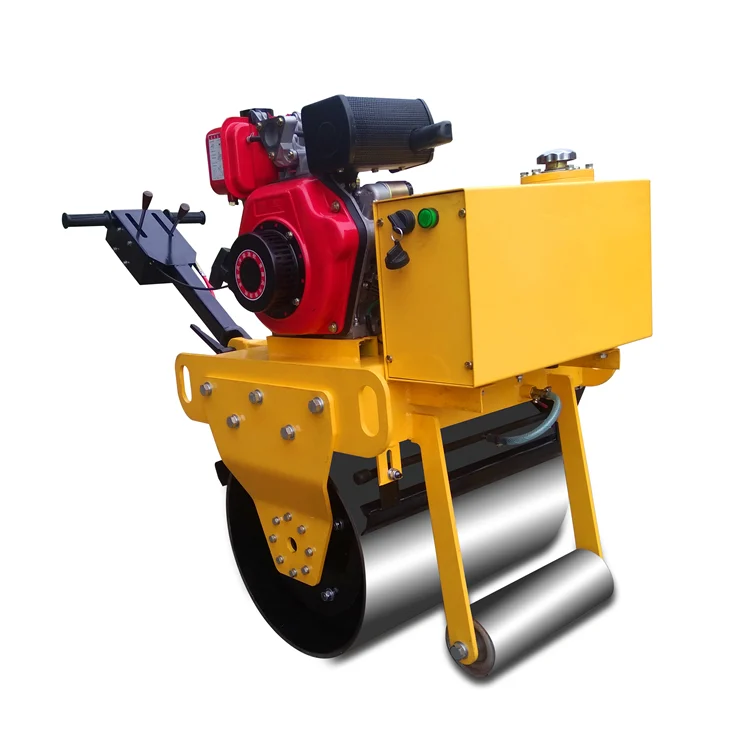
Why Walk Behind Rollers Deliver Superior Compaction Efficiency
Labor and Time Savings on Small-to-Medium Grading Projects
Walk behind rollers significantly reduce manual effort and accelerate timelines on small-to-medium grading jobs. Their compact, agile design enables a single operator to navigate tight spaces—around manholes, curbs, and utility trenches—without constant repositioning. This maneuverability cuts project duration by up to 40% compared to larger ride-on compactors, which require more passes and wider turning radii. Labor costs drop accordingly: one skilled operator handles the full compaction sequence, eliminating the need for multiple crew members or support equipment. Fewer machines on site also lower fuel use and daily mobilization time. For tasks like backfilling narrow sewer lines or prepping residential driveway subbases, walk behind rollers achieve uniform compaction in half the passes required by plate compactors—enabling faster lift turnover, improved schedule adherence, and quicker return on equipment investment—all while maintaining precise density levels right up to structural edges.
The Science: How Weight Distribution and Vibration Frequency Optimize Soil Density
Effective compaction hinges on the calibrated interplay of static weight and dynamic vibration. A walk behind roller’s operating weight applies downward pressure, but it’s the drum’s vibration that forces soil particles into a denser, more stable configuration. Amplitude—the vertical drum stroke—determines how deeply compaction energy penetrates: higher amplitude suits thicker lifts and granular soils, while lower amplitude prevents over-compaction near the surface. Frequency (measured in Hertz) governs impact rate per second; higher frequencies (55–70 Hz) rapidly densify upper layers, whereas lower frequencies penetrate deeper—making them ideal for cohesive clays. Modern rollers with load-sensing technology automatically adjust frequency and amplitude to match real-time soil stiffness, avoiding wasted energy and surface damage. Precisely engineered weight distribution ensures consistent ground contact across the full drum width, preventing uneven density pockets. Together, these forces efficiently expel air voids, raising dry density to specification in fewer passes than static rollers.
Choosing the Right Walk Behind Roller for Your Job Site
Matching Drum Width, Operating Weight, and Amplitude to Soil Type and Lift Thickness
Selecting the correct walk behind roller starts with a precise analysis of the soil type, as granular and cohesive materials respond to fundamentally different compaction forces. Drum width affects coverage and agility in confined areas—but must be paired with sufficient operating weight to generate required static pressure. For cohesive soils like clay, a single smooth or padfoot drum model with high-amplitude vibration is essential to drive energy deep into thicker lifts and break down persistent air voids. Granular soils such as sand respond best to lower-amplitude, higher-frequency vibration that settles particles quickly without over-compacting. A common oversight is selecting a drum too narrow for the intended lift thickness, which risks inconsistent density and future pavement failure. Successful matching therefore requires aligning the machine’s centrifugal force rating with the soil’s Proctor density curve.
| Drum Configuration | Ideal Soil Type | Key Compaction Mechanism | Lift Thickness (Max) |
|---|---|---|---|
| Single Smooth Drum | Granular (Sand, Gravel) | High-Frequency Vibration (Low Amplitude) | 10–15 cm (4–6 in) |
| Single Padfoot Drum | Cohesive (Clay, Silt) | High-Amplitude Vibration (Kneading Effect) | 15–25 cm (6–10 in) |
| Double Smooth Drum | Asphalt & Fine-Graded Base | Static Weight & Vibration (Mat Finish) | 5–8 cm (2–3 in) |
Electric vs. Gas: Evaluating Multi-Mode Walk Behind Rollers for Urban and Noise-Sensitive Sites
The power source of a walk behind roller directly impacts scheduling and regulatory compliance—especially in urban or noise-sensitive environments. Gasoline and diesel engines deliver high power density for heavy-duty soil work but often exceed 90 dB, violating municipal noise ordinances near hospitals, schools, or residential zones. In contrast, electric-powered vibratory rollers produce zero exhaust emissions and operate at dramatically lower noise levels, enabling nighttime or indoor use without ventilation systems or acoustic barriers. This flexibility can shorten urban infill project timelines where daytime traffic disruption penalties are steep. Modern lithium-ion battery systems now support full-shift operation on a single charge—refuting outdated assumptions about electric limitations. The decision should therefore prioritize operational risk: not just upfront cost, but the financial exposure from noise violations, air-quality noncompliance, or forced work stoppages.
Proven Operational Best Practices for Maximum Walk Behind Roller Uptime
Daily Maintenance Essentials vs. Data-Driven Predictive Service Scheduling
Daily maintenance remains the frontline defense for walk behind roller reliability: cleaning drums of debris, checking hydraulic fluid levels, and allowing the vibration system to idle briefly before shutdown. These simple habits prevent cumulative wear that leads to costly failures. Yet many fleets still rely solely on fixed-interval servicing, despite data showing preventable issues cause up to 30% of unscheduled downtime (EquipmentWatch, 2022). By contrast, data-driven predictive service scheduling uses telematics and oil analysis to forecast component wear—triggering interventions only when needed. This shifts maintenance from reactive to proactive, reducing labor hours and part costs while extending machine life. The most effective uptime strategy balances hands-on daily inspections with sensor-based alerts, empowering operators to combine experiential knowledge with real-time machine health insights.
Real-World Impact: Measuring ROI with Walk Behind Rollers
Calculating the return on investment for a walk behind roller goes beyond purchase price versus rental cost. A comprehensive analysis must weigh tangible line-item savings against high-impact operational gains. For example, replacing weekly rentals of ride-on rollers—typically $800–$1,500 per week—with an owned walk behind model eliminates recurring fees. Cutting just three weeks of rental time per season recovers $2,400–$4,500 annually—a figure that often shortens the payback period to under 18 months.
The greater financial impact lies in project velocity and resource optimization. The precision and maneuverability of walk behind rollers allow a single operator to achieve target density in fewer passes than bulkier alternatives—a process documented to reduce compaction time by 15–20% on complex utility trenches. When scaled across a season, this time saving effectively adds one or two additional billable projects to the crew’s capacity. Equally important are intangible benefits: ergonomic design reduces operator fatigue, contributing to fewer safety incidents and lower insurance claims. Industry analysis shows that consistent, fatigue-resistant operation can lower lost-time incident rates by up to 12%—a direct contributor to improved margins and long-term profitability.
FAQ
Why are walk behind rollers preferred for small-to-medium grading projects?
Walk behind rollers are preferred because of their compact design and maneuverability, which allow operators to work efficiently in tight spaces while reducing project timelines and labor costs.
How do vibration frequency and amplitude affect soil compaction?
Vibration frequency and amplitude determine how deeply compaction energy penetrates soil. Higher frequencies work on upper layers, while higher amplitudes are ideal for deeper penetration in thicker lifts.
What factors should be considered when choosing a walk behind roller?
Key considerations include soil type, drum width, operating weight, and amplitude. Ensuring alignment with soil conditions and lift thickness is essential for achieving uniform compaction.
Are electric-powered walk behind rollers better than gas-powered rollers?
Electric-powered rollers are quieter, emission-free, and ideal for noise-sensitive environments. Gas-powered rollers offer higher power density for heavy-duty work but may violate urban noise and air-quality regulations.
What maintenance practices ensure maximum uptime for walk behind rollers?
Daily checks (e.g., cleaning drums, checking hydraulic fluid) and predictive service scheduling using telematics and data analysis help prevent downtime and maintain optimal performance.
