EN
EN
 AR
AR CS
CS DA
DA NL
NL FI
FI FR
FR DE
DE IT
IT NO
NO KO
KO PL
PL PT
PT RO
RO RU
RU ES
ES SV
SV TL
TL ID
ID LV
LV SR
SR SK
SK SL
SL VI
VI SQ
SQ ET
ET TH
TH TR
TR AF
AF MS
MS GA
GA HY
HY KA
KA BS
BS LA
LA MN
MN MY
MY KK
KK UZ
UZ KY
KY
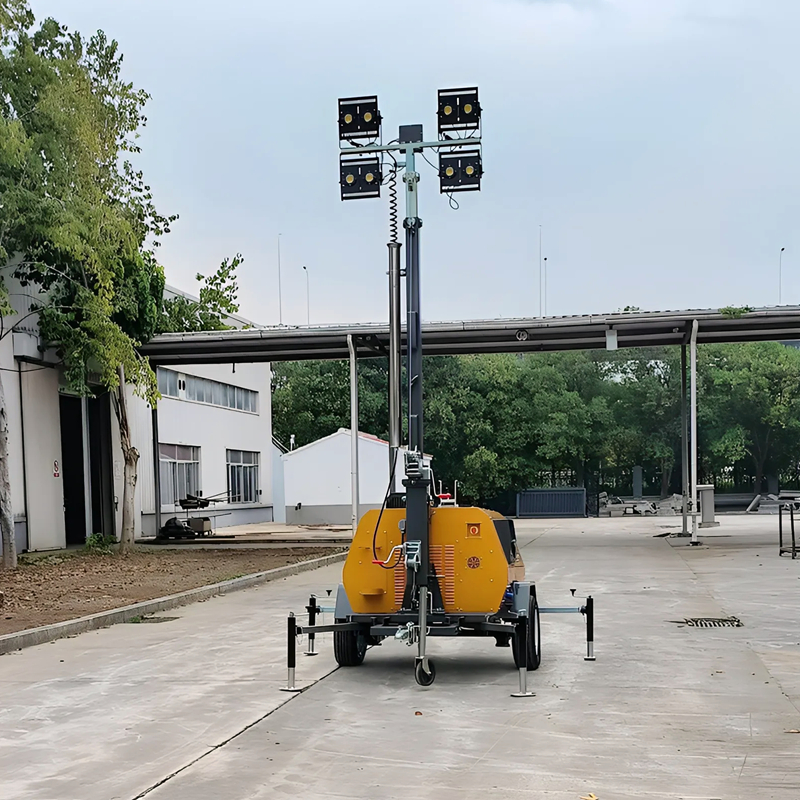
Power Source Options for Mobile Lighting Towers
Diesel vs. Electric vs. Solar vs. Hydrogen: A Comparative Analysis
Today's mobile lighting towers typically run on four main power sources, all with their own advantages and drawbacks. Diesel remains a go-to choice because it packs so much energy into one tank, giving anywhere from 12 to almost 50 hours of light before needing more fuel. That makes them great for places far from civilization, but obviously they spew carbon dioxide as they work. Electric versions don't produce any exhaust fumes at all, which is nice, but they need access to electricity lines or backup generators, making them less practical when moving around. Solar powered towers cut down running expenses by roughly half to three quarters compared to diesel according to research from Luxman Solar Institute back in 2023. Plus they're completely silent and work well near nature reserves where pollution matters most. The downside? They only perform reliably when sunny outside and need decent batteries to store energy. Hydrogen fuel cells represent the newest frontier here, offering clean operation similar to diesel's runtime capabilities. However, these systems aren't really taking off yet mainly because there just aren't enough places to refill them right now.
Evaluating Hybrid Systems for Reliable Off-Grid Performance
Combining different power sources like diesel and solar or hydrogen with batteries helps get around problems that come with relying on just one type of energy. Take a look at what happened in 2023 with an off grid construction project. When they added solar panels to work alongside their diesel generator, fuel usage dropped by about 40 percent. The system stayed online nearly all the time too, hitting close to 98% uptime even when clouds rolled in for days. This was possible because the setup automatically switched between power sources as needed. For these mixed power systems to really work well, there are several important things to consider.
- Fuel-saving threshold activation (e.g., solar engages when battery charge exceeds 30%)
- Redundant charging ports for rapid battery replenishment
- Compatibility with alternative fuels like biodiesel
These systems offer improved sustainability without sacrificing reliability, making them ideal for extended off-grid operations.
Fuel Capacity and Runtime: Matching Power to Project Duration
Runtime depends on both fuel capacity and energy efficiency. For example, a 25-liter diesel tank powers four 1,000W LED lamps for 18 hours but only 11 hours with less efficient metal halide bulbs. Solar towers need 20–30% larger battery banks for multi-day use compared to single-night deployments.
| Power Source | Avg. Runtime (hrs) | Ideal Application |
|---|---|---|
| Diesel | 12–48 | Remote construction sites |
| Solar + Battery | 8–14 | Eco-sensitive event zones |
| Hydrogen | 24–36 | Emergency response |
| Electric | Unlimited* | Urban infrastructure |
*When grid-connected
Select towers with clear fuel-consumption metrics (e.g., liters/hour at full load) and ensure tanks or chargers align with your team's logistical capabilities.
Illumination Performance: Brightness, Coverage, and Light Quality
Key Metrics: Understanding Lumens, Lux, and Luminous Angle
When talking about how well lighting works, there are basically three main things to consider: lumens, lux, and the angle at which light spreads out. Lumens tell us how much light comes from a source overall. Industrial LED towers usually put out somewhere between 20,000 and 60,000 lumens. For instance, a standard 400 watt LED setup might give around 40,000 lumens, which is actually comparable to having fifteen regular old 100 watt incandescent bulbs running at once, but uses about two thirds less power according to PAClights research from last year. Then we have lux, which basically tells us how intense the light is over a certain area. Most construction sites need only about 50 to 100 lux for basic work, but when workers need to see fine details clearly, they generally require something closer to 200 to 500 lux instead.
The luminous angle determines beam spread. Narrow beams (e.g., 30°) focus light over long distances, whereas wide angles (up to 120°) provide broad area coverage.
Mast Height and Adjustability: Maximizing Light Spread
Telescopic masts (20–35 feet) enhance adaptability across job sites. Elevating a tower from 20 to 30 feet increases coverage area by up to 40%. Adjustable masts also minimize shadows in uneven terrain, improving visibility and safety.
Color Temperature and Application-Specific Lighting Needs
When we talk about light quality, what really matters is something called color temperature, which gets measured in those Kelvin units everyone keeps mentioning. For folks working late night shifts, warm white lighting around 3000K tends to be gentler on tired eyes. On the flip side, when someone needs to inspect things closely, cool white at about 5000K makes colors pop and details stand out better. There's another factor worth considering too: the Color Rendering Index, or CRI for short. Lights with a CRI above 80 do a much better job showing true colors, which becomes absolutely essential for firefighters reading warning signs or maintenance crews spotting different pipe markings in low light conditions.
Case Study: Optimizing Illumination on a Nighttime Construction Site
A highway expansion project deployed four 50,000-lumen LED towers with 30-foot adjustable masts and 5000K lighting. This configuration achieved 95% coverage uniformity at an average of 150 lux, meeting IESNA standards for high-risk environments and reducing nighttime accident rates by 60%.
LED vs. Traditional Lighting: Efficiency, Lifespan, and Value
Energy Consumption and Light Efficiency in Modern LED Towers
LED mobile lighting towers these days use between half to three quarters less power compared to old school metal halide setups, yet they still shine just as bright or even better in many cases. Take a standard 10 kW LED unit for instance it can crank out well over 12 thousand lumens but does so with about thirty percent less wattage. The secret? Directional beam technology that gets over ninety percent efficiency from the light output. Throw in some solar panels and these hybrid systems really start making sense. They slash reliance on fossil fuels and construction sites typically save around three thousand five hundred dollars each year when running nonstop operations. Makes a lot of sense for anyone looking to cut costs without sacrificing quality lighting.
Lifespan and Maintenance: Metal Halide vs. LED Technology
LEDs last 50,000–100,000 hours (10–20 years), ten times longer than metal halide lamps (10,000-hour lifespan). This dramatically reduces maintenance needs—especially in harsh environments like mining sites—cutting labor costs by up to 80%. Real-world data shows LED towers lower total ownership costs by 45% over time.
Are Traditional Lamps Still Viable in Today’s Market?
These days, metal halide towers account for under 5% of all new equipment purchases. Still, they hang on in specific situations where really bright lighting (over 20,000 lux) matters or when working in super cold conditions down to -40 degrees Fahrenheit. Most contractors though are going with LED mobile towers instead. Around 8 out of 10 professionals have made the switch because these LED units restart instantly after power cuts, cut down on carbon emissions significantly about 12 tons of CO2 saved each year per tower actually and work great with solar panels and battery backup systems. The combination of reliability and environmental benefits makes them hard to beat in most applications nowadays.
Portability, Durability, and Environmental Resilience
Trailer Design and Tow-Behind Features for On-Site Mobility
Towers with optimized trailer designs reduce setup time by 30% compared to static units (ConstructionTech 2023). Features such as articulating hitches, foldable masts, and lightweight aluminum frames improve maneuverability and transport efficiency. Adjustable tow bars and standardized coupling heights ensure compatibility with common vehicles.
Wheel Configuration, Braking Systems, and Build Quality
Dual-axle setups with all-terrain tires enhance stability on rough surfaces, while electric brakes improve towing control. High-strength steel chassis with welded joints withstand up to 2.5 Gs of vibration—essential for demanding applications like mining and emergency response.
IP Ratings, Corrosion Resistance, and All-Weather Performance
Units rated IP65 or higher resist dust and low-pressure water jets, making them suitable for coastal or rainy environments. Powder-coated aluminum housings resist salt corrosion three times longer than untreated steel (Durability Lab 2023), ensuring longevity in harsh conditions.
Ruggedness Standards for Harsh Environments (Mining, Emergency Response)
Lighting towers used in mining must meet MIL-STD-810G standards for shock and vibration resistance, operating reliably from -30°C to 55°C. Explosion-proof wiring and pressurized enclosures are critical in volatile atmospheres, ensuring safety and compliance.
Selecting the Right Mobile Lighting Tower for Your Application
Construction Sites: Balancing Brightness, Portability, and Noise
When working at night on construction sites, look for lighting towers that put out around 28,000 lumens or more. These units can light up spaces over 50,000 square feet, which according to OSHA data from 2022 actually cuts down accident rates by about 34%. Most contractors swear by these high output lights after seeing the difference they make safety-wise. For easier setup and moving between job sites, go for models with collapsible masts and generators that don't exceed 75 decibels of noise. Many cities have strict rules about how loud equipment can be, so keeping noise levels down is practically mandatory in urban areas. The hybrid diesel electric systems are really taking off in this space right now. They typically run for about 72 hours straight, giving crews enough power without constantly refueling. Plus, these hybrids manage to stay portable despite their long runtime capabilities.
Event Lighting: Aesthetic and Quiet Operation Requirements
Event planners benefit from 5700K color temperature LED arrays that render natural skin tones and minimize glare. Solar-powered units with battery backups eliminate fumes and noise, supporting sustainable events. With 92% of venues now enforcing <55 dB limits during performances, quiet electric or hydrogen models are increasingly preferred.
Emergency and Disaster Response: Rapid Deployment and Reliability
When equipping first responders, the towers need components rated at least IP55 protection against dust and water ingress, plus they should deploy within 15 minutes maximum. The ideal setup includes those rugged 6x6 all terrain wheels that can handle rough conditions anywhere. For power options, look for tri fuel generators that work with regular gas, propane tanks, or even diesel fuel depending on what's available at the scene. Many top quality models actually exceed FEMA standards with around 99.8 percent reliability when temperatures swing between minus 30 degrees Celsius and up to 50 degrees. These systems are built tough enough for military service and come with satellite based monitoring so technicians can check status remotely. What makes them really valuable today is their modular design which lets teams attach various communication equipment right onto the unit, making coordination much smoother during emergency operations in the field.
Remote Mining Operations: Advantages of Solar-Powered Lighting Towers
Mining operations that aren't connected to the grid can really benefit from those solar hybrid towers with their 8 kW PV arrays and batteries that last for 96 hours straight. According to research done last year, companies saw their fuel expenses drop around two thirds when they switched to these systems, all while keeping lights at about 98 lux brightness day and night through round-the-clock work shifts. The auto tilt feature on the solar panels helps them track the sun better, and robots clean the masts regularly so dust doesn't build up - something that matters a lot in places like the Australian Pilbara region or copper mines in Chile where sand gets everywhere. Solar tech has come a long way too; portable units now pack 40 percent more energy than they did back in 2020, which means even cold spots near the poles are starting to look feasible for solar power solutions.
FAQ
What are the main power sources for mobile lighting towers?
The main power sources for mobile lighting towers are diesel, electric, solar, and hydrogen.
What are the advantages of using LED lighting towers over traditional lamps?
LED lighting towers offer significant energy savings, longer lifespans, lower maintenance costs, and better environmental impact compared to traditional lamps like metal halide.
What factors should be considered when selecting a mobile lighting tower?
Considerations should include power source, runtime, illumination performance, portability, and environmental resilience specific to the intended application.
How do hybrid systems enhance the performance of mobile lighting towers?
Hybrid systems combine power sources, such as diesel and solar, to optimize fuel efficiency and reliability, providing flexibility and sustainability for off-grid use.
What are the ideal lighting conditions for construction sites at night?
Lighting conditions should provide at least 28,000 lumens to cover large areas and ensure safety, with considerations for portability, noise, and runtime.
Table of Contents
- Power Source Options for Mobile Lighting Towers
- Illumination Performance: Brightness, Coverage, and Light Quality
- LED vs. Traditional Lighting: Efficiency, Lifespan, and Value
- Portability, Durability, and Environmental Resilience
- Selecting the Right Mobile Lighting Tower for Your Application
-
FAQ
- What are the main power sources for mobile lighting towers?
- What are the advantages of using LED lighting towers over traditional lamps?
- What factors should be considered when selecting a mobile lighting tower?
- How do hybrid systems enhance the performance of mobile lighting towers?
- What are the ideal lighting conditions for construction sites at night?