 EN
 AR
 CS
 DA
 NL
 FI
 FR
 DE
 IT
 NO
 KO
 PL
 PT
 RO
 RU
 ES
 SV
 TL
 ID
 LV
 SR
 SK
 SL
 VI
 SQ
 ET
 TH
 TR
 AF
 MS
 GA
 HY
 KA
 BS
 LA
 MN
 MY
 KK
 UZ
 KY

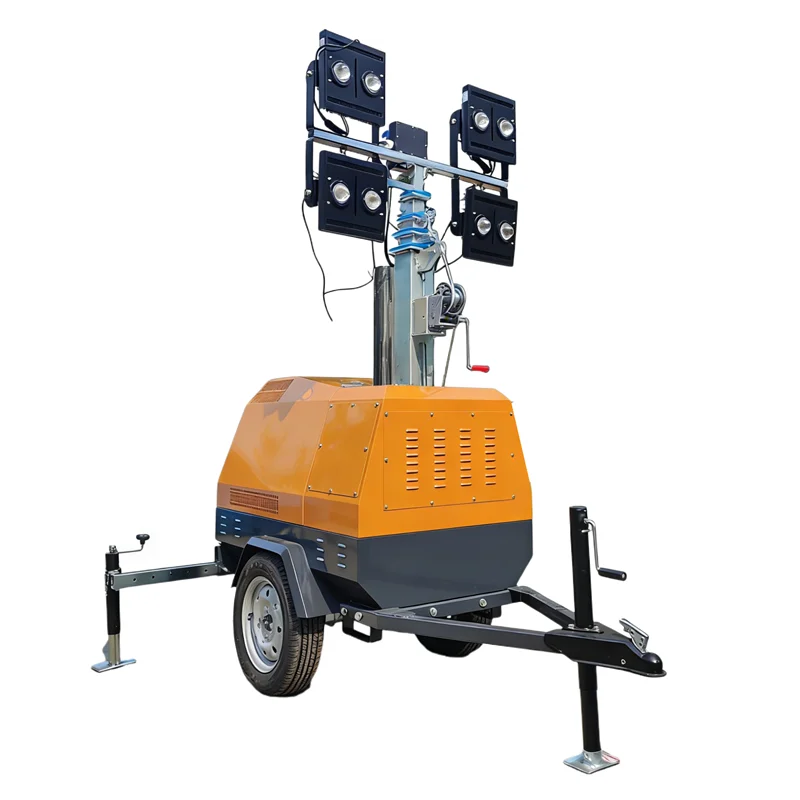
Matching Trailer Specifications to Your Mobile Lighting Tower
Weight Capacity, Dimensions, and Stability Requirements
Selecting a trailer that matches your mobile lighting tower’s total weight is the foundational safety step. A complete system—including mast, luminaires, generator, and full fuel tank—typically weighs between 1,500 and 5,000 lbs. Per ASME best practices, the trailer’s GVWR should exceed the loaded tower weight by at least 25%: for example, a 3,000-lb tower requires a minimum 3,750-lb-rated trailer. Bed dimensions must fully accommodate the tower’s footprint—no overhang or compromised mounting points—and a wide track width (60 inches or greater) lowers the center of gravity and significantly improves resistance to tipping. Field data from a 2023 survey of rental fleet managers confirms this: 68% of reported tip-over incidents involved trailers with narrow track widths. Outriggers enhance stability—but only when the base trailer is properly matched to the load. A robust frame and appropriately rated axle are essential to withstand both static weight and dynamic forces encountered while towing over uneven terrain, preventing long-term sagging and preserving steering predictability.
Axle Configuration and Ground Clearance for Off-Road Mobility
Axle configuration directly determines how well a mobile lighting tower handles rough job sites. Single-axle trailers offer light weight and pavement agility but become unstable off-road due to lateral sway. Tandem-axle designs distribute weight across a broader footprint and deliver markedly improved stability: SAE International (2022) found they reduce side-to-side movement by an average of 40% in off-road conditions compared to single-axle units. Suspension type further refines performance—leaf springs absorb heavy impacts, while independent torsion axles provide smoother articulation and maintain consistent tire contact. Ground clearance is equally critical: construction, mining, and event sites often require at least 12 inches beneath the trailer to avoid striking debris or ruts. Pairing a tandem-axle trailer with all-terrain tires and a high-clearance frame enables precise positioning of the tower where illumination is needed—without risking undercarriage damage or loss of control.
Mounting Systems and Structural Integration for Mobile Lighting Towers
The interface between the mast package and trailer chassis governs long-term structural integrity. A poorly engineered mounting system accelerates frame fatigue and reduces operational availability.
Fixed-Mount vs. Quick-Release Platforms: Durability and Deployment Speed
The choice between fixed-mount and quick-release platforms reflects a core trade-off: structural longevity versus deployment speed. Fixed-mount systems—welded or heavily bolted directly to the trailer frame—create a monolithic structure that minimizes stress concentrations and joint wear. With proper maintenance, they typically deliver a 15-year structural lifespan. However, full removal or replacement requires 45–60 minutes and often a crane. Quick-release platforms use standardized locking pins, twist-lock mechanisms, or hydraulic clamps, enabling a single technician to detach the unit in under 15 minutes—no heavy equipment needed. This speed comes with a mechanical compromise: micro-tolerances in the interface can become failure points under repeated vibration and dynamic loading. On rough roads, play may develop in locking components, accelerating wear. Financially, one leading provider measured a 23% reduction in planned downtime offset by a 12% increase in long-term component replacement cycles for quick-release units. The optimal choice depends on operational tempo and access to calibrated torque tools for routine bolt inspections.
| Criteria | Fixed-Mount (Welded/Bolted) | Quick-Release Platform |
|---|---|---|
| Structural Integrity | High rigidity; minimal joint fatigue. | Micro-tolerances introduce potential failure points under vibration. |
| Swap-Out Time | 45–60 minutes (often requires lifting equipment). | < 15 minutes (usually single-operator). |
| Long-Term Wear | Low; passive structural component. | High; active locking mechanisms require frequent inspection. |
| Financial Impact | Higher initial fabrication cost; almost zero interface maintenance. | Lower upfront cost; potential for 12% higher long-term parts replacement ($740 k average downtime cost, Ponemon 2023). |
Vibration Control and Frame Reinforcement Standards (ISO 10892-2)
A mast extended to 8 meters acts as a long moment arm, amplifying subtle road vibrations into destructive low-frequency oscillations at the turret base. ISO 10892-2 establishes structural integrity and vibration control requirements for towing frames used with mobile lighting towers. Compliance mandates engineered isolation at the mast-to-frame connection—commonly achieved through polyurethane mounts or coil-spring absorbers with precisely tuned durometer ratings. Frame reinforcement must go beyond standard channel iron: high-cycle fatigue analysis often dictates adding cross-bracing gussets and continuous internal stiffeners along the primary load path. As confirmed by SAE research, proper damper tuning and optimized stiffener geometry can reduce resonant stress amplitude by 60–80%, preventing weld toe crystallization and extending chassis fatigue life by up to tenfold.
Towing Safety and Real-World Mobility for Mobile Lighting Towers
GVWR Calculations: Ensuring a Minimum 1.5× Safety Margin Over Tower Weight
Towing safety begins with disciplined GVWR calculation. Industry best practice dictates that the fully loaded tower—including fuel, engine fluids, and mast components—must not exceed two-thirds of the trailer’s stated GVWR. This enforces a minimum 1.5× safety margin. For example, a 600 kg (1,320 lb) tower requires a trailer rated for at least 900 kg (1,980 lb). This buffer is non-negotiable: it accounts for dynamic forces like emergency braking or sharp swerving, during which tongue weight can spike dangerously if the tow vehicle or trailer is near capacity. Operating without this reserve increases risks of catastrophic trailer sway and accelerated frame fatigue—especially on uneven worksite terrain. A rigorously calculated GVWR reserve ensures the mobile lighting tower remains a safe, relocatable asset—not just a stationary fixture.
Critical Tow Components: Hitches, Braking, and Compliance
Class III/IV Receiver vs. Gooseneck Hitches: FMCSA Incident Data Insights
For mobile lighting towers—often exceeding 4,000 lbs with a high center of gravity—the hitch type critically influences roll stability and detachment risk. Gooseneck hitches transfer tongue weight directly over the tow vehicle’s rear axle, inherently improving sway resistance. FMCSA’s 2022 Large Truck Crash Causation Study found gooseneck couplings reduced coupling-related crashes by 35% on trailers over 6,000 lbs, thanks to their ball-and-socket design’s superior absorption of lateral and vertical forces. That said, a properly rated Class IV receiver hitch—paired with an integrated sway-control system—can deliver comparable stability for towers under 10,000 lbs, provided its rating exceeds the fully loaded tower weight by at least 20%. This margin accommodates dynamic loads during abrupt braking. Crucially, FMCSA records show 17% of tow-away incidents on light-duty trailers stem from worn hitch pins, corroded receiver tubes, or under-torqued fasteners—underscoring the necessity of rigorous pre-trip inspection.
Safety Chain Ratings, Breakaway Brakes, and DOT Lighting Requirements
DOT regulations and SAE J684 require safety chains with a combined working load limit equal to or greater than the trailer’s gross vehicle weight. Chains must be crossed under the tongue to form a cradle in case of coupler separation. For dual-axle mobile lighting towers, grade-70 5/16-inch chains—with a working load limit above 5,000 lbs—are typical. A breakaway brake system must automatically engage the trailer’s electric brakes within 15 seconds of separation (SAE J2936), using a dedicated battery capable of holding the brakes fully applied. Lighting compliance follows DOT FMVSS 108: amber side marker lamps are required on towers wider than 80 inches, and red rear reflectors must be visible. Telescoping masts must be fully stowed to remain under the 13-ft-6-in legal height limit, and all light circuits should be tested with every hookup. Consistent integration of these components reduces roadside out-of-service orders—and, more importantly, prevents catastrophic loss of the tower on public roads.
FAQ Section
What is the minimum trailer weight rating for mobile lighting towers?
You need a trailer with a Gross Vehicle Weight Rating (GVWR) that exceeds the fully loaded lighting tower’s weight by at least 25%.
Why are tandem-axle trailers recommended for off-road conditions?
Tandem-axle trailers distribute weight across a broader footprint, improving stability and reducing lateral sway on uneven terrains.
What are the key differences between fixed-mounts and quick-release platforms?
Fixed-mounts provide high structural rigidity and minimal joint fatigue but take longer to swap out. Quick-release platforms offer faster unit deployment but may have higher wear due to dynamic loading.
What does the 1.5× GVWR safety margin mean?
To ensure towing safety, the fully loaded tower weight should not exceed two-thirds of the trailer’s GVWR—a buffer that accounts for dynamic forces like emergency braking or swerving.
How can road vibrations affect the frame's integrity?
Road vibrations can amplify structural oscillations and cause fatigue in the frame. Compliance with ISO 10892-2 standards ensures effective vibration control mechanisms are in place.
Table of Contents
- Matching Trailer Specifications to Your Mobile Lighting Tower
- Mounting Systems and Structural Integration for Mobile Lighting Towers
- Towing Safety and Real-World Mobility for Mobile Lighting Towers
- Critical Tow Components: Hitches, Braking, and Compliance
-
FAQ Section
- What is the minimum trailer weight rating for mobile lighting towers?
- Why are tandem-axle trailers recommended for off-road conditions?
- What are the key differences between fixed-mounts and quick-release platforms?
- What does the 1.5× GVWR safety margin mean?
- How can road vibrations affect the frame's integrity?
