EN
EN
 AR
AR CS
CS DA
DA NL
NL FI
FI FR
FR DE
DE IT
IT NO
NO KO
KO PL
PL PT
PT RO
RO RU
RU ES
ES SV
SV TL
TL ID
ID LV
LV SR
SR SK
SK SL
SL VI
VI SQ
SQ ET
ET TH
TH TR
TR AF
AF MS
MS GA
GA HY
HY KA
KA BS
BS LA
LA MN
MN MY
MY KK
KK UZ
UZ KY
KY
Match Road Roller Type to Soil Type and Compaction Mechanism
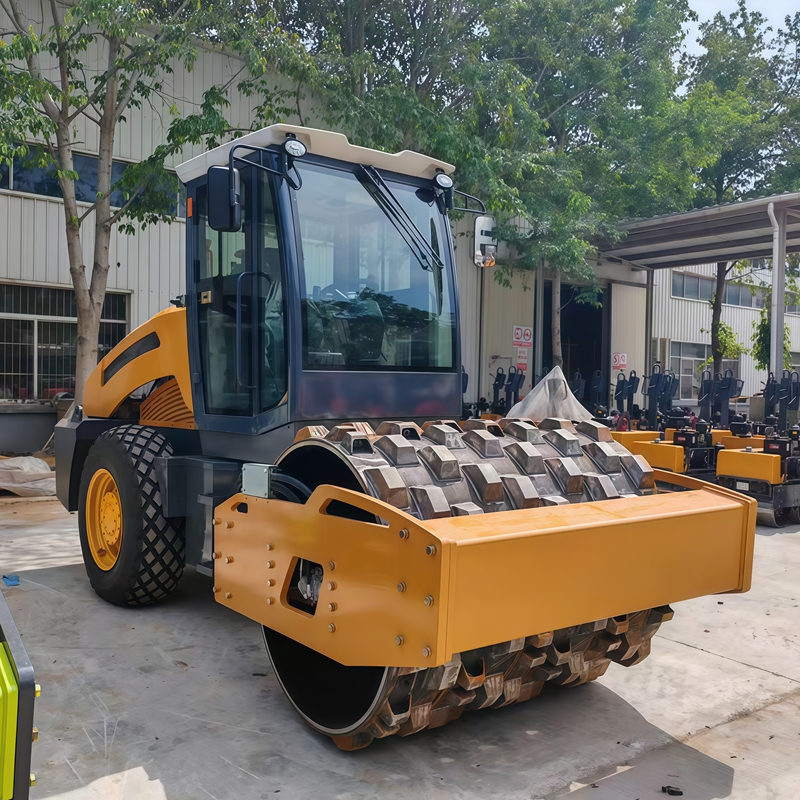
Padfoot Rollers for Cohesive Soils: Achieving Deep Shear Compaction
The special design of padfoot rollers features those tapered, sticking-out feet that create intense shear forces needed to compact sticky soils like clay and silt effectively. Regular static pressure just doesn't work well on these tightly bound soils, but padfoot rollers actually break apart soil clumps deep down while keeping the surface pretty much intact. These machines apply point loads between 500 to 700 psi, making it possible to compact 300 mm layers in only 4 to 6 passes across the ground. Most tests show they hit around 95% relative density according to ASTM D698 standards. Getting good results really depends on getting the moisture levels right though. If the clay gets too wet or dry beyond about plus or minus 2%, the whole compaction process becomes way less effective, maybe even 60% worse. Choosing the right type of padfoot roller matters a lot for building embankments and preparing subgrades for big infrastructure projects. The wrong choice can lead to problems like sinking subgrades or uneven settling later on. What makes them work so well is how they focus all that force straight down instead of spreading it out sideways.
Vibratory Rollers for Granular Soils: Leveraging Resonance and Particle Densification
When it comes to working with granular soils like sand, gravel, and crushed stone, vibratory rollers have become pretty much the go-to equipment these days. Instead of just relying on heavy weights sitting there, they work through dynamic oscillations that get things moving. The frequencies typically range from around 25 to 40 Hz, which creates resonance among the particles. This basically cuts down on the friction between grains and allows them to rearrange themselves much quicker into tighter packs. Studies indicate that vibrations can reach target density levels up to half the time compared to traditional static compaction methods when dealing with good quality gravel. Getting the right settings matters a lot though. Sands generally respond best to frequencies between 30 and 35 Hz with amplitudes of about 0.8 to 1.4 mm. Coarser gravel needs lower frequencies, maybe around 25 to 28 Hz, but requires bigger amplitude movements, somewhere between 1.4 and 1.8 mm. What all this does is significantly reduce empty spaces in the soil matrix, leading to roughly a 30 to 40 percent boost in California Bearing Ratio (CBR). And that means better road surfaces that can handle heavier traffic loads without breaking down as quickly.
Smooth Drum and Pneumatic Rollers: Uniform Pressure for Finishing and Variable Moisture Soils
| Roller Type | Best Application | Key Benefit |
|---|---|---|
| Smooth Drum | Asphalt sealing, thin granular lifts | Uniform static pressure for surface finish |
| Pneumatic | Marginal soils, variable moisture | Adjustable tire pressure accommodates hydration variations |
Smooth drum rollers work best when we need gentle but consistent compression for those final layers of asphalt or when dealing with shallow granular lifts under 150 mm thick. They preserve the integrity of aggregates without going overboard. Pneumatic rollers typically come with between five and nine rubber tires, which means they can adapt their ground pressure from around 50 to 350 psi depending on what the soil needs. This flexibility helps redistribute water evenly through silty clay soils without creating dangerous shear planes that could compromise stability. When working with mixed or borderline quality soils, these pneumatic setups usually hit at least 90% compaction even if moisture levels vary by plus or minus 8%. That makes them really valuable tools in situations where getting that perfect optimum moisture content determined in lab tests just isn't practical out there on actual job sites.
Optimize Road Roller Weight and Amplitude Based on Soil Moisture and Layer Depth
Targeting Optimal Moisture Content: How Dry or Wet Soils Influence Required Compaction Force
Soil moisture governs compaction response. At Optimum Moisture Content (OMC), particles lubricate sufficiently to maximize density with minimal energy input. Deviations require strategic equipment adjustments:
- Dry soils resist particle rearrangement, demanding heavier rollers (≈12 tons) or increased vibration amplitude to generate adequate stress.
- Wet soils, especially near saturation, lose shear strength under load—requiring lighter equipment (6–8 tons), reduced pass counts, or staged drying to avoid displacement and pumping.
Field data confirms the sensitivity: compacting at 10% below OMC increases required passes by 25%, while exceeding OMC by 15% can reduce CBR by up to 40%. Real-time moisture monitoring—not just lab-derived OMC—is essential for adaptive roller selection.
Layer Thickness Guidelines: Selecting ≈12-Ton Vibratory Rollers for Layers Over 250 mm
Compaction depth scales predictably with roller mass and vibration intensity. Matching equipment to lift thickness ensures uniform density from surface to base:
| Layer Depth | Recommended Roller Type | Key Settings |
|---|---|---|
| <150 mm | 8–10 ton smooth drum | Medium amplitude (1.0–1.4 mm) |
| 150–250 mm | 10–12 ton padfoot | High amplitude (1.8–2.2 mm) |
| >250 mm | ≈12 ton vibratory | Dual amplitude (1.5–2.5 mm) + 25–35 Hz frequency |
Contractors consistently report achieving 95% density in half the passes when equipment aligns with layer depth. For granular base courses exceeding 300 mm, tandem vibratory rollers operating at 2,500–3,000 vpm deliver deep energy penetration while preserving surface uniformity—critical for structural longevity.
Align Road Roller Configuration with Project Application and Site Constraints
Embankments and Foundations: High-Amplitude Tandem Rollers for Deep Lift Compaction
When it comes to compacting embankments and foundational layers, tandem vibratory rollers set the standard, especially when running at those high amplitude settings between 15 and 25 kN. The dual drum setup creates pretty consistent pressure across the surface, often reaching over 400 kPa which gets most cohesive soils up to about 95% density down to around 300 mm depth. What this means on site is fewer air pockets forming below ground and less risk of uneven settling problems showing up later in structures like bridges, retaining walls, or building pads. For areas where soil is already saturated, crews need to watch their frequency levels, keeping them at 30 Hz or lower while making sure they complete at least eight passes per layer. Checking progress through either visual signs of no further settlement or using those nuclear density gauges helps confirm everything meets spec requirements.
Trench Backfilling: Compact Articulated Padfoot Rollers for Confined Access
Rollers with articulated padfeet weighing less than 2 tons are specifically designed for working in tight spots like trenches and utility corridors. These machines can make complete 180 degree turns even in passages just over a meter wide thanks to their pivoting joints. The special cleat pattern creates controlled shear planes that compact granular material down to at least 90% density without moving pipes out of place. When dealing with trenches deeper than 1.2 meters, operators often switch to remote control versions which keep workers safe from the dangers of confined spaces. According to field tests, these compactors reduce the need for rework by around 40% when compared to traditional plate compactors. They deliver consistent results that can be tracked and verified in places where standard rollers simply won't fit.
Avoid Common Road Roller Selection Mistakes That Reduce Efficiency and Soil Strength
Over-Compaction Risks: Field Data Showing 37% Drop in CBR on Silty Loam from Excessive Passes
The problem of over compaction isn't just something we talk about in theory—it actually happens and costs money. Field tests back in 2023 showed that when working with silty loam soils, the California Bearing Ratio dropped by around 37% after eight roller passes or more. When there's too much vibration during compaction, it breaks those natural soil bonds, turning what was once stable ground into weak powdery layers that won't hold together. What makes this so dangerous is how quietly it happens. The surface might look settled down, but underneath everything could be falling apart. Experienced operators know better than to keep adding passes just because they don't see any more settling on top. Instead, they should stop right there at the point where no further settlement occurs. Before starting each new pass though, checking both moisture levels and how thick the layer being compacted really is becomes absolutely essential for good results.
Decompaction in Sands: How High-Frequency Vibration Disrupts Particle Interlocking
When vibrations go beyond what granular soils can handle at their natural resonance point, these materials start to lose compaction. Sands get displaced when oscillations hit over about 30 Hz, which breaks how the grains fit together and can drop density somewhere around 15%. This effect really stands out in sands that have uniform particle sizes without much fine material mixed in. To counteract this, engineers need to get the frequencies just right. Medium range vibratory rollers working between roughly 20 to 25 Hz work best when combined with controls that adjust amplitude as needed. These setups keep the sand grains aligned properly while letting those tiny particles settle down and hold everything in place. Soil types require specific frequency ranges according to what manufacturers recommend, not just whatever comes preset on equipment. Getting this right makes all the difference in maintaining proper density levels after compaction efforts.
FAQ
What does a padfoot roller do?
Padfoot rollers are designed to compact cohesive soils such as clay and silt. They achieve deep shear compaction through tapered feet that apply intense shear forces, breaking apart soil clumps deep down.
How do vibratory rollers work with granular soils?
Vibratory rollers use dynamic oscillations with frequencies ranging from 25 to 40 Hz, creating resonance among particles. This reduces friction between grains, allowing them to rearrange into tighter packs, enhancing density quickly.
When should I use pneumatic rollers?
Pneumatic rollers are suitable for marginal soils with variable moisture content. Their adjustable tire pressure accommodates hydration variations, redistributing water evenly without compromising stability.
Why is real-time moisture monitoring important?
Moisture content significantly impacts soil compaction. Real-time monitoring ensures soil moisture is optimal, allowing for adaptive equipment adjustments. It helps avoid under or over-compaction.
What mistakes can reduce road roller efficiency?
Common mistakes include over-compaction, where excessive passes weaken soil structure, or incorrect frequency settings, which can disrupt particle interlocking in granular soils.
Table of Contents
- Match Road Roller Type to Soil Type and Compaction Mechanism
- Optimize Road Roller Weight and Amplitude Based on Soil Moisture and Layer Depth
- Align Road Roller Configuration with Project Application and Site Constraints
- Avoid Common Road Roller Selection Mistakes That Reduce Efficiency and Soil Strength