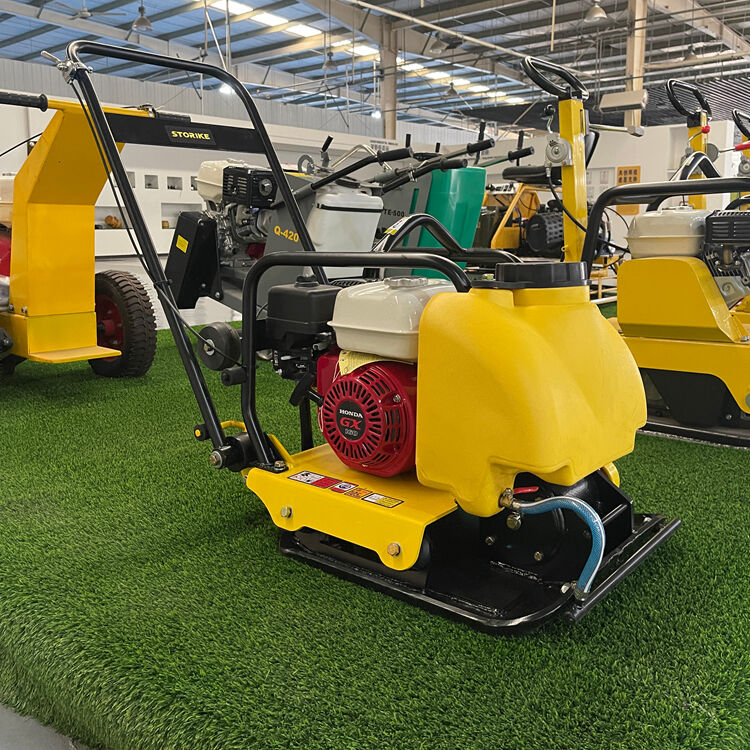
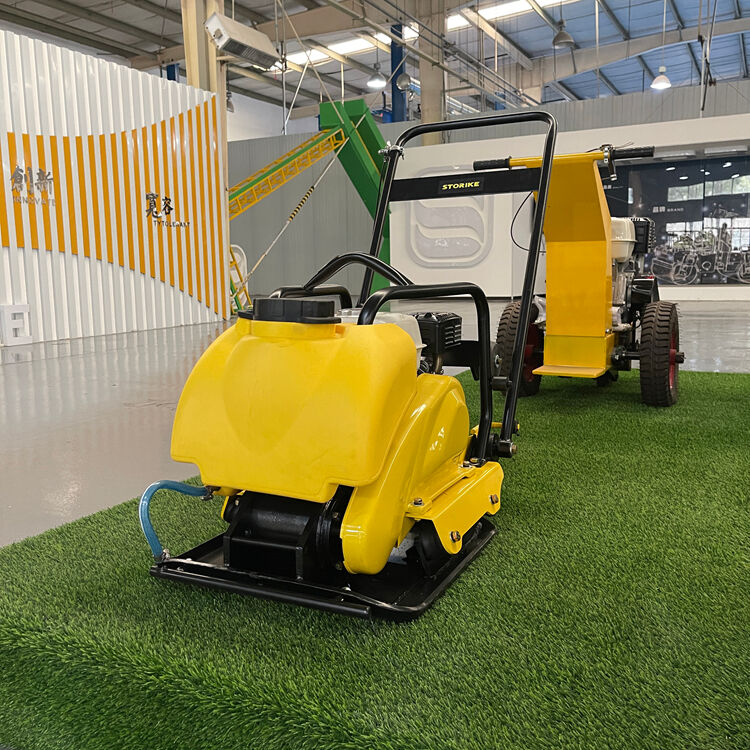
Gravel, a common aggregate material used for base courses, drainage layers, and surfacing, requires specific compaction energy to achieve interlock and stability. A plate compactor designed for gravel compaction delivers high-amplitude vibrations that are particularly effective for arranging and settling coarse, irregularly shaped stones. The goal is to force the gravel particles to rearrange, fracture any weak stones, and pack together into a dense, stable matrix that can distribute loads effectively. The key difference when compacting gravel, compared to sand or asphalt, is the need for a greater "throwing" force or amplitude to move the larger particles. Plate compactors for this application are engineered to provide this optimal vibration characteristic. A critical application is in road construction, where a compacted gravel base course is fundamental to the pavement's longevity. Similarly, for driveways, parking areas, and pedestrian paths, a well-compacted gravel foundation prevents rutting, pothole formation, and settling over time. When used for surface gravel, such as on a decorative driveway or a country road, compaction creates a smoother, more durable riding surface that is resistant to washboarding. The process typically involves spreading the gravel in thin layers (lifts) and making multiple passes with the compactor. The machine's base plate must be robust enough to withstand abrasion from the sharp stones. Water is often sprinkled on the gravel during compaction to slightly dampen the material, which helps to reduce dust and can temporarily provide a lubricating effect that aids in particle rearrangement. For professional advice on selecting the right plate compactor with the appropriate amplitude and centrifugal force for your specific gravel type and project, we encourage you to contact us. Our experts can provide recommendations based on material gradation and desired density.
Copyright © by 2025 Shandong Storike Engineering Machinery Co., Ltd.